Moby landing pages

Build the page. Measure the lift. Make more money.

Moby builds brand-matched landing pages from your offer, creative, product catalog, and Shopify theme—then connects every page to the performance data that makes the next one smarter.

Book a landing-page demo

Native Shopify publishing. Pixel measurement. A faster path from each result to the next page.

Landing-page engine
01 · Brief 02 · Build 03 · Publish 04 · Learn
Landing pages PDPs Collections Homepages Offer pages Ad-specific pages Landing pages PDPs Collections Homepages Offer pages Ad-specific pages

Conversion philosophy

Small hinges move large doors.

A small conversion-rate gain compounds across every visitor you already paid to acquire.

The opportunity is not just “make a nicer page.” It is to connect message match, page speed, merchandising, measurement, and iteration in one operating loop.

01 / TrafficVisitors
02 / Intent× Better message match
03 / Conversion× CVR
04 / Economics× AOV
05 / Outcome= More revenue

One connected system

Create. Ship. Measure. Improve.

The strongest landing-page program is not a design project with a finish line. It is a repeatable operating system tied directly to the ads, offers, products, and data that shape demand.

Input01

Match the moment.

Start from a specific ad, audience, offer, product, or launch—not a generic page brief.

Build02

Use what the brand already owns.

Moby can work from product imagery and the Shopify theme so the page feels native, not bolted on.

Publish03

Push it to Shopify.

Move from draft to a native storefront experience without creating another disconnected publishing workflow.

Learn04

Let the Pixel close the loop.

Track how the page performs, find friction, and use the signal to decide what Moby should build next.

Built with Moby

Pages already out in the world.

Three different brands, three different jobs. Beauty merchandising, air-quality storytelling, and a sale event—all built as distinct customer journeys rather than one reusable template.

Visual preview for the live BreatheSmart 45i cleaner-air landing page Live URL · visual preview
Alen / Product education

Cleaner air. A more comfortable home.

A focused education page that turns an air-purifier product into a clear household outcome.

pages.app.triplewhale.com/naTebFLA7DSE
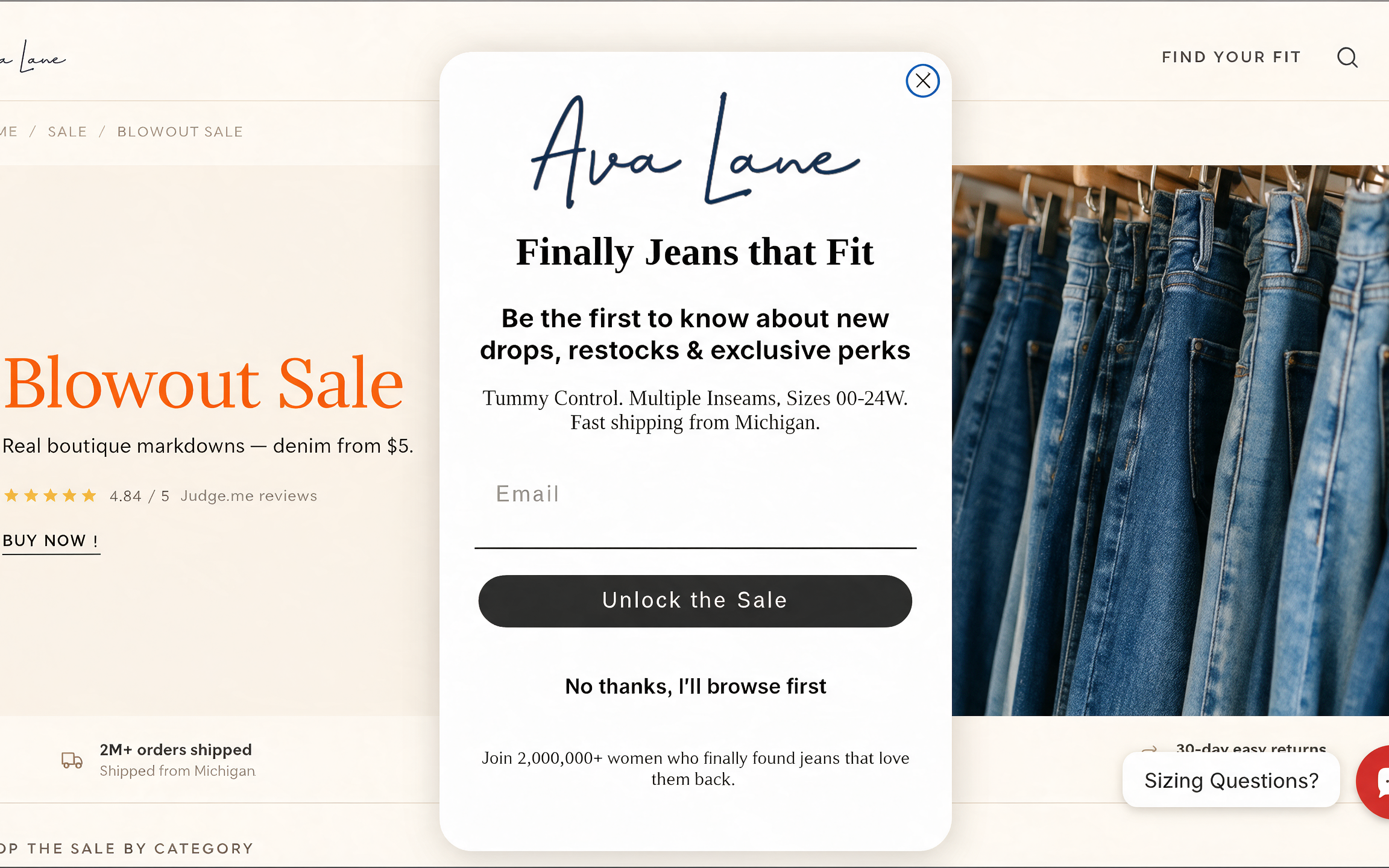
Visual preview for the live Ava Lane Boutique Blowout Sale landing page Live URL · visual preview
Ava Lane Boutique / Sale event

A focused storefront for a blowout sale.

A campaign-specific sale destination designed to make the event and the shopping path immediate.

avalaneboutique.com/apps/load/blowout-sale

Conversion impact calculator

What is a little more conversion worth?

Use your own monthly traffic, AOV, and conversion rates. The calculator shows the revenue difference if the same traffic converts at the target rate.

people
Use sessions or unique visitors—just stay consistent.
USD
%
%
Try moving this by only 0.1–0.5 percentage points.
Potential incremental monthly revenue

$34,000

Moving conversion from 2.4% to 2.8% on the same 100,000 visitors adds an estimated 400 orders.

Current revenue $204,000
Projected revenue $238,000
Relative lift 16.7%

Illustrative math only. It assumes traffic and AOV remain constant and does not account for margins, returns, discounts, channel mix, or statistical confidence.

Build at the speed of the campaign

One generic page is not enough.

When the page can be created and measured quickly, the destination can become as specific as the campaign that sends traffic to it.

Ad → page01

Match the creative.

Carry the same promise, product focus, language, and visual world from the ad into the first screen of the page.

Offer → page02

Make the deal obvious.

Build a destination for the exact bundle, launch, sale, gift, or seasonal offer instead of asking a generic PDP to do every job.

Audience → page03

Speak to the use case.

Reorder the story around what matters to the audience—without rebuilding the brand from scratch every time.

Learning → next page04

Turn signal into output.

Use measurement and specialist analysis to decide which headline, offer structure, proof, or merchandising treatment deserves the next iteration.

More than campaign pages

Moby can work across the storefront.

01 Landing pages Focused journeys for ads, offers, launches, audiences, and special campaigns.
02 PDPs Product detail pages that make the value, offer, variants, proof, and purchase path clearer.
03 Collections Merchandising systems for drops, categories, sale events, and higher-intent product discovery.
04 Homepages A sharper top-level brand story with clear routes into products, offers, and high-value customer journeys.

The unified advantage

The page and the measurement system should know each other.

Moby is not starting from a blank canvas. It can work from the commerce context around the page: your products, imagery, theme, campaign intent, and the performance signal that comes back after launch.

Brand contextProduct imagery and the Shopify theme shape the page.
Campaign contextThe ad, audience, and offer define the job.
Measurement contextThe Pixel helps show what happened after the click.
Operator contextMoby or a specialist can turn the findings into the next build.
Campaign input Offer, audience, and ad promise
Brand input Products, imagery, and theme
Published output Native Shopify experience
Performance signal Pixel data informs the next page
Moby page systemLive loop
BuildShipLearn
Brief → build → Shopify → Pixel → next page

FAQ

The practical questions.

What kinds of pages can Moby build?
Moby can help build focused landing pages, product detail pages, collection experiences, and homepages. The best starting point is a clear job: a specific ad, offer, launch, audience, product, or merchandising problem.
Can the pages be pushed into Shopify?
The workflow is designed around native Shopify publishing so the page can live with the storefront rather than as a disconnected prototype. The exact implementation should preserve the store’s real theme, navigation, product data, cart flow, and tracking requirements.
How does the Pixel help?
The Pixel connects the page to the performance loop. It helps the team evaluate what happened after traffic arrived and gives Moby or a specialist more context for the next iteration. Measurement definitions, attribution model, and date windows still matter when drawing conclusions.
Can every ad have its own page?
That is the promise of building at scale: create destinations for the ads and offers that deserve them. It does not mean cloning pages blindly. Each variation should have a clear hypothesis, meaningful traffic, clean measurement, and a reason to exist.
Does Moby replace a CRO team or designer?
Moby creates leverage across the workflow—research, synthesis, page creation, publishing, analysis, and iteration. Human taste, brand judgment, merchandising knowledge, and experimental discipline remain important, especially for consequential site changes.
What should we build first?
Start where message mismatch or commercial upside is most obvious: a high-spend ad sending traffic to a generic destination, a major offer without a focused page, a high-traffic PDP with visible friction, or a collection that does not help shoppers choose.

Put the storefront to work

Your next page should learn from the last one.

Launch one page, measure what changes, and use that signal to shape the next offer, ad, PDP, collection, or homepage with more confidence.

Book your landing-page demo