Moby / Long-running media buyer / Always on
Get out of Ads Manager. Moby keeps the account moving.
Campaigns, ad sets, and ads still move. You just stop living inside the tabs. Moby watches the account, prepares the changes, routes approvals, and carries the work through — automatically inside policy or waiting for you at the boundary.
Observe→Reason→Govern→Act→Verify→Remember
Illustrative workflows only. No live account is connected and no campaign can be changed from this page.
Liberation from Ads Manager
The ads move. You leave the tabs.
f Ads ManagerAccount active
CampaignsAd setsAds
DeliveryObjectStatus
Campaign 01Prospecting / portfolioActive
Ad set 04Broad / exclusions appliedActive
Ad 12New product filmReview
Campaign 02Returning customersActive
CampaignReady
Ad setCleared
AdApproved
Out of the managerInto the market
Work in motion
Budget / executingMove spend toward higher-confidence campaigns.Portfolio neutral / policy passed
Creative / queuedRotate a fatigued hook without rebuilding structure.Creative review required
Audiences / monitoringRefresh high-value cohorts and converter exclusions.Destination sync healthy
GeoLift / designingTurn measurement disagreement into the next test.Power and holdouts in review
Current account decision / budget + pacingAutomatic inside policy
Shift the smallest responsible object. Then verify what happened.
MeasurementJourney and Compass support the same direction.
BenchmarkPeer movement says this is not auction weather.
Business contextInventory and customer economics can absorb demand.
Operating policyInside the approved daily move and protected-object rules.
Lower-confidence campaign−$1,200/day
Higher-confidence campaign+$1,200/day
Policy owner / Media BuyerRead window, action size, permission, reversal, and receipt are attached.
Cleared to execute
01Observe
02Reason
03Govern
04Act
05Verify
BudgetsBidsAudiencesExclusionsCreativeGeoLift
From evidence to a reviewable account changeReal action surface / governed before execution
One continuous operating record
01 / SignalRead the account and business.
02 / SpecialistBring the right judgment.
03 / PolicyCheck boundaries and owner.
04 / ReviewApprove, reject, or revise.
05 / ReceiptExecute, verify, remember.
Moby action reviewNew ads + campaign budgets
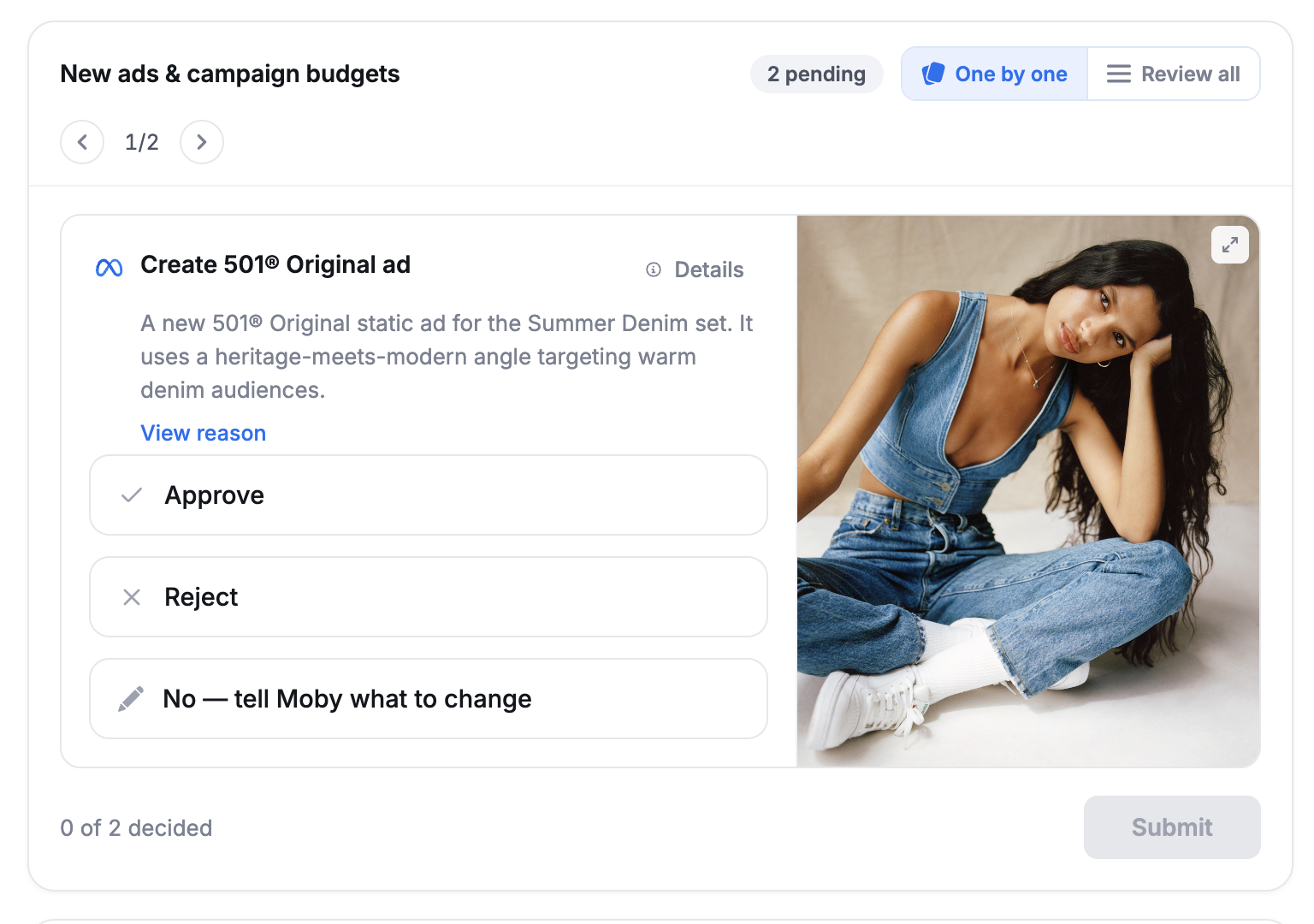
Product capture shown as supplied. The marketing page itself is not connected to an ad account and cannot change campaigns.
Govern + act
Moby works the loop. You control the boundary.
Run automatically inside policy, or keep the decisive account change behind a human approval.
RecommendationPolicyApprovalAccount actionVerify
The long-running agent is the media buyerMemory + tools + specialists + governed hands
MobyPersistent media buyerObserve, decide, act, verify, and keep the learning.
Trusted truthAttribution, MMM, incrementality, customer journey.
Outside contextPeer benchmarks and market weather around the account.
Durable memoryBrand policy, exceptions, history, and prior outcomes.
SpecialistsMedia buying, creative, audiences, inventory, measurement.
AutomationsRecurring monitors, scheduled work, and exception handling.
Authorized handsBudgets, bids, audiences, exclusions, ads, and GeoLift.
One harness routes every job to the right tool and control mode.
ObserveReasonGovernActVerifyRemember
Current condition
A promotion begins in eighteen hours.
+12%
Staged portfolio move
01 / Verify
Check promotion inventory and prior event pacing.
02 / Context
Protect new-customer economics across the mix.
03 / Govern
Stage the move now and release it through approval.
Recommended account action
Planned execution confidence
Prepare a +12% portfolio-neutral move for approval.
The budget is ready before the event starts, but it cannot cross the gate until the owner reviews the exact current-to-proposed state.
Waiting for approval
Owner: Promotion policy
Neutral journeyNot platform self-report
Market contextPeer + industry weather
Business contextStock + customer value
Governed handsPermission + approval + receipt
01 / Automatic media buyingPersistent agent / governed action
The media buyer is the agent
Moby keeps working after the dashboard closes.
This is not a one-time allocation answer. Moby is a long-running media buyer with the account context, memory, tools, Specialists, permissions, and operating policy to keep the work moving. It can monitor, diagnose, propose, act, verify, and remember what happened next.
Review mode Every consequential action waits for approval.
Automatic mode Repeatable actions run inside explicit policy.
What the agent can work on
Not one lever. The media-buying surface.
The same loop can route different jobs to the right tool and the right approval contract. The action changes; the operating discipline stays the same.
Approval requiredMoby prepares the exact change and waits. You can approve it, reject it, or ask for a revision.
Automatic within policyMoby runs repeatable work only inside the target, threshold, window, permission, and action size you defined.
Always reviewableEvery run keeps the evidence, action receipt, outcome, and reversal path attached to the operating record.
02 / The problemEveryone grades their own homework
The first instrument is trust
Three platforms can claim the same order.
A buyer cannot allocate capital from five competing versions of reality. Moby starts with a merchant-owned journey, so the decision has one neutral record beneath it.
Customer journey resolverFirst touch → order truth
Every signal, one readable sequenceMoby follows the path before diagnosing the outcome
EM
EmailFirst engagementGO
GoogleSearch intentME
MetaAd interactionTT
TikTokVideo discoveryWEB
WebsiteOn-site sessionSHOP
ShopifyCheckout event01
OrderMerchant truthM
Moby reconstructs the route before judging the channel.The journey remains visible while the attribution lens changes.
Journey resolved
03 / The instrumentsOne seat, full context
A media buyer is only as good as the desk around the seat.
The model is not the scarce part. The scarce part is the trusted journey, the normalized feed, the outside reference, the inventory join, the customer memory, and the governor that makes real action safe.
Instrument index
TrustNeutral journey
FeedCurrent + history
WeatherPeer context
ShelfInventory truth
ClocksCustomer economics
HandsGoverned action
SeatYour policy
Measurement truthTrust
Resolve the merchant-owned journey before judging a channel.
Live contextFeed
Read current delivery with enough history to know what changed.
Compass contextWeather
Separate account work from market-wide movement.
Inventory boundaryShelf
Never create demand the warehouse cannot fulfill.
Customer horizonClocks
Judge channels across first order and longer-term value.
Governed actionHands
Move money with permission, approval, and a receipt.
Operating policySeat
Apply the same decision rules every time.
MobyMedia Buyer
Instrument 01 / Trust
Start with a neutral journey.
When channels argue over an order, somebody neutral has to be in the room. Moby can reason across attribution models because the customer journey beneath them is merchant-owned and consistent.
InputFirst-party sessions, devices, touches, and orders.
DecisionWhich channel actually contributed to the customer journey?
BoundaryNo single model is treated as sacred or silently blended.
Independent journey recordOrder / Example
MetaPlatform claim
GooglePlatform claim
EmailPlatform claim
One stitched path, three visible contributions.Change the attribution lens without changing the underlying customer record.
Journey owned
Instruments 02–03 / Feed + Weather
Know if it is you — or the market.
A number without context is not a signal. Moby sees the live movement, the historical pattern, and the peer set around it, so a rough auction does not trigger an unnecessary account rebuild.
FeedCurrent channel delivery normalized against history.
WeatherPeer and industry movement over the exact same window.
OutcomeHold when the sea moved; work when the account diverged.
Brand vs peer movementIllustrative 7-day view
Your CPM
Nearest peers
Category range
Moves togetherHold.
The market got expensive for everyone. Do not punish a healthy account for auction weather.
Brand divergesGet to work.
Investigate creative, offer, landing-page, and delivery changes inside the account.
04 / The deskContext before capital
Concept film / 04 seconds
Every instrument has a job. The seat sees all of them.
A media buyer who sees the benchmark but not the inventory, or the ROAS but not the cohort, is still allocating from a partial world. The point is not more dashboards. The point is one decision-maker with the whole desk.
Instrument 04 / The shelf
Do not scale demand past the stock.
The ad platforms do not know what is in the warehouse. Moby can connect the creative that sold the order to the SKU and its run rate before recommending another dollar of demand.
JoinAd → order → SKU → units and days of stock.
RiskMarketing can work perfectly for orders the brand cannot ship.
Green lightDeep stock on a hero SKU makes confident scaling possible.
Inventory pressure
9 daysat current velocity
Scaling is capped before the campaign creates demand the shelf cannot fulfill.
Creative → SKU link
The winning creative is mapped to the variant it actually sells, not only the campaign it lives in.
Instrument 05 / The clocks
First order is one clock. Customer value is another.
A channel that looks expensive today can still build the better customer base. Moby can move between first-order efficiency and longer-horizon value without collapsing the two into one unlabeled metric.
DailyROAS, CPA, pacing, delivery, and creative movement.
QuarterlyLTV, AOV, new-customer efficiency, and cohort quality.
DecisionGive patience to the channels that compound.
Channel economicsIllustrative cohort view
TikTok
$38
Google
$52
Protect Google. It starts stronger on the first order.
Switch the clock before making a quarterly allocation decision.
05 / Decision labSpecific jobs, one operator
Not a chat demo. A decision system.
Change the situation and the evidence path changes with it. Moby consults the right instruments, applies the policy, and returns a recommendation with an approval state.
Media Buyer scenario labIllustrative / no campaign mutations
Situation
The auction got expensive overnight.
+29%
Brand CPM
01 / ReadVerify the movement in the merchant-owned journey.
02 / ComparePlace the brand beside its nearest peers.
03 / DecideSeparate market weather from account work.
04 / GovernRespect the minimum read window.
Hold the structure. The market moved with you.
No action required / policy satisfied
06 / Moby at workObserve → reason → govern → act → verify
Moby does not stop at a recommendation. It stays on the account.
Putting every signal in one place is only the foundation. Moby is the long-running harness around the media-buying job: it keeps the business memory, calls Specialists when the work needs deeper judgment, turns decisions into automations, takes governed account action, verifies the result, and brings the learning into the next run.
Memory+Data+Measurement+Specialists+Automations+Actions
Moby account operating loop
One shared context / working continuously
01
Observe
Continuously read the journey, spend, delivery, inventory, customer economics, market context, and account state.
02
Reason
Bring the right Specialist, skill, measurement method, benchmark, and prior decision into the same working context.
03
Govern
Check the policy, read window, target, action size, protected objects, owner, permission, and approval mode.
04
Action
Use the owning connection to shift spend, change bids, manage audiences, launch creative, or schedule the test.
05
Verify + remember
Log the receipt, watch the outcome, reverse exceptions, and attach the result to the next operating decision.
Specialist crewShared Moby context
Media Buyer
Measurement
Inventory
Creative
Audiences
Recommended account action
Ready for review
Media Buyer Specialist / Budget action
Reallocate $1,200/day toward the higher-confidence campaign.
JourneyContribution held across 7 completed days.
CompassMeasurement signals support the direction.
InventoryHealthy stock supports additional demand.
PolicyPortfolio neutral and inside the change limit.
Current daily budget$10,000
Proposed daily budget$11,200
Illustrative product workflow. This page is not connected to an ad account and cannot change a campaign. In-product actions use authorized connections, permissions, approvals, logs, and the operating policy configured for the account.
Instrument 06 / The hands
The job is not reading. The job is moving money.
Real action needs a governor. Every consequential recommendation should show the current state, proposed state, trigger, read window, source, owner, portfolio impact, approval, and reversal path.
PermissionWhat the operator may touch, and what it may not.
ApprovalA visible gate before consequential change.
ReceiptWhat changed, why, by whom, and reversible how.
Illustrative governed actionPortfolio-neutral move
Current daily budget$10,000
→
Proposed daily budget$11,200
TriggerHealthy stock + stable NC contribution.
Read window7 completed days.
SourceMerchant journey + channel delivery + inventory.
Net portfolio impact$0 — funded from lower-confidence spend.
OwnerMedia Buyer operating policy.
ReversalRestore prior budgets from the action receipt.
Instrument 07 / The seat
Your judgment becomes persistent operating memory.
Read windows, maximum daily changes, promo calendars, protected campaigns, audience rules, inventory checks, and prior exceptions should not live only in one buyer's head. Moby carries them forward as reviewable skills, policy, and account memory.
Write itCodify the rules that define a safe, good decision.
Run itApply the same policy across every recommendation, automation, and account action.
Remember itChange the policy without losing the decisions, approvals, exceptions, and outcomes behind it.
Media Buyer operating policySkill / Example
01Never move more than 20% in one day.Active
02Check stock before scaling a creative or product set.Active
03Do not touch protected brand campaigns without approval.Active
04Use the exact required read window for every scorecard decision.Active
05Pause all spend after one bad hour.Rejected
07 / MeasurementThree methods that fail differently
Complex brands need triangulation
Agreement is confidence. Disagreement is the next test.
First-party attribution gives a faster operational read on journeys and orders. MMM estimates aggregate contribution, marginal return, and saturation. Incrementality tests causal lift. Compass organizes the confidence and disagreement; where available, Moby can use that context to support a reviewed decision.
Operate / MTAFirst-party attributionCustomer paths and daily conversion signals.
Plan / MMMMarketing mixIncremental contribution and marginal return.
Validate / GEOLift testsCausal validation when confidence needs proof.
Compass signal theaterConvergence detected
AttributionJourney-level contribution and customer paths.
MMMTop-down incremental contribution and saturation.
IncrementalityCausal lift from a controlled experiment.
Higher confidenceSignals agree
Decision confidence84%
Where they agree, the account can move with more confidence.Definitions stay separate.
08 / Signal flowMarket context enters the route
Compass context / measurement loop
Three signals. One reviewable direction.
Compass does not force every source to agree. It helps surface what is well-supported, what is directional, and what needs another test. Moby can use that context where available, then carry the recommendation through policy, permission, and approval.
09 / Keep the loop runningMoby / Media Buyer
One long-running agent. The whole media-buying job.
Moby is built to operate the media-buying loop over time: watch the business, remember what matters, call the right Specialist, decide with evidence, take the authorized action, verify the result, and carry the learning into the next run.